|
Alessandro Aimi I'm a research fellow at University of Bologna in Italy, working under Prof. Paolo Bellavista in the Mobile Middleware Research Group of the Department of Computer Science and Engineering. I did my PhD at CNAM in Paris, France, where I was advised by Prof. Stefano Secci and worked as research scientist at Orange Labs. Before that, I received both a MSc and BSc in Computer Science and Engineering from Polytechnic University of Milan, Italy. |
|
ResearchI'm interested in low-power IoT networks, network simulation, modeling and optimization, QoS-driven resource allocation, and Cloud infrastructures. I also maintain the lorawan module of the ns-3 network simulator. Some papers are highlighted. |
|
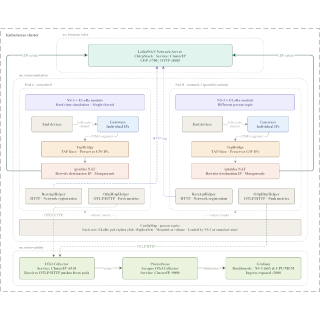
Kubernetes-Based Real-Time LoRaWAN Emulation Toward Network Digital Twins
Alessandro Aimi, Michele Brigadoi, Andrea Sabbioni, Armir Bujari, DS-RT, 2026 doi / bibtex Integrating ns-3, ELoRa and real network servers in a Kubernetes framework to automate reproducible, real-time emulation and testing of large-scale LoRaWAN deployments. |
|
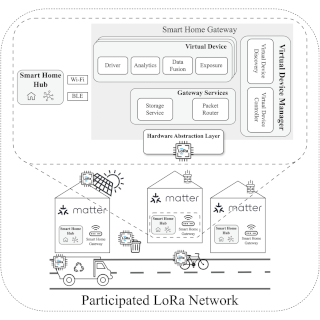
CLUES: Community-Driven LoRa Networks Urban Sensing Empowered by Smart Homes
Alessandro Aimi, Andrea Sabbioni, Armir Bujari, Paolo Bellavista, Pietro Manzoni IEEE Network, 2026 doi / bibtex / code Putting citizen-owned smart LoRa gateways into homes to enable decentralized, community-driven urban sensing with scalable coverage and shared local data services. |
|
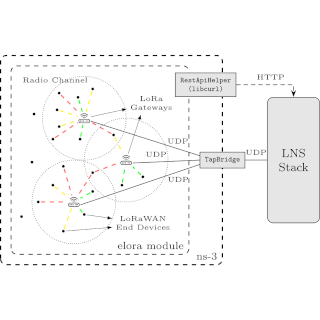
ELoRa: End-to-end Emulation of Massive IoT LoRaWAN Infrastructures
Alessandro Aimi, Stéphane Rovedakis, Fabrice Guillemin, Stefano Secci IEEE/IFIP NOMS, 2023 doi / bibtex / code ELoRa integrates ns-3 with ChirpStack to emulate realistic LoRaWAN traffic and anomalies at scale, enabling live testing of orchestration and radio resource allocation techniques. |
|
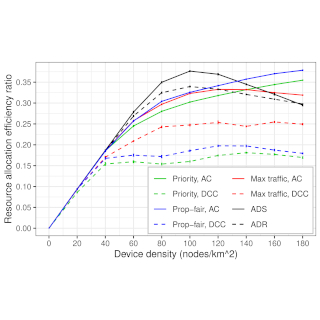
Traffic Control and Channel Assignment for Quality Differentiation in Dense Urban LoRaWANs
Alessandro Aimi, Stéphane Rovedakis, Fabrice Guillemin, Stefano Secci WiOpt, 2022 doi / bibtex Traffic control and channel assignment policies can be used for service-quality differentiation in dense LoRaWAN deployments, with improvements in packet delivery, device servicing rates, and network operator revenue. |
|
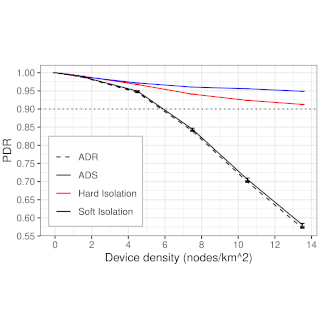
Packet Delivery Ratio Guarantees for Differentiated LoRaWAN Services
Alessandro Aimi, Stéphane Rovedakis, Fabrice Guillemin, Stefano Secci IEEE GLOBECOM, 2022 doi / bibtex An access-control method to isolate device clusters in LoRaWAN and meet differentiated packet delivery targets with improved fairness, at the cost of reduced network range. |
|
Credits to Jon Barron for the website design. |